
Navarro County Criminal Court Cases
Navarro County does not have one criminal clerk for every charge. The 13th District Court, the county's sole general-jurisdiction district court, hears felony matters. Its records are kept by the District Clerk in Suite 201 of the Navarro County Courthouse. The County Clerk keeps Class A and Class B misdemeanor files for the County Court at Law from Suite 101. These files may involve DWI, theft, assault, or drug allegations at the misdemeanor level.
Fine-only Class C charges and ordinance matters remain in the municipal or justice court that handled them. Navarro County has four justice courts, while Corsicana, Kerens, and Rice each maintain municipal court dockets. A person who searches only the county clerk index can therefore miss a lower-court case. Court jurisdiction follows the filed charge, not merely the agency that made an arrest. The correct Navarro County court file begins where the prosecutor or issuing court placed the case.
Navarro County Court Case Counters
The two courthouse suites answer different record questions. Suite 201 is the District Clerk's felony counter. It is open weekdays from 8:00 a.m. to 5:00 p.m., and the office can be reached at 903-654-3040. Suite 101 is the County Clerk's criminal department for Class A and B misdemeanors. Its public counter is open from 8:00 a.m. to noon and from 1:00 to 4:30 p.m.; the number is 903-654-3035. The split lunch schedule matters when a reader plans a same-day Navarro County case request, as shown on the official District Clerk page.
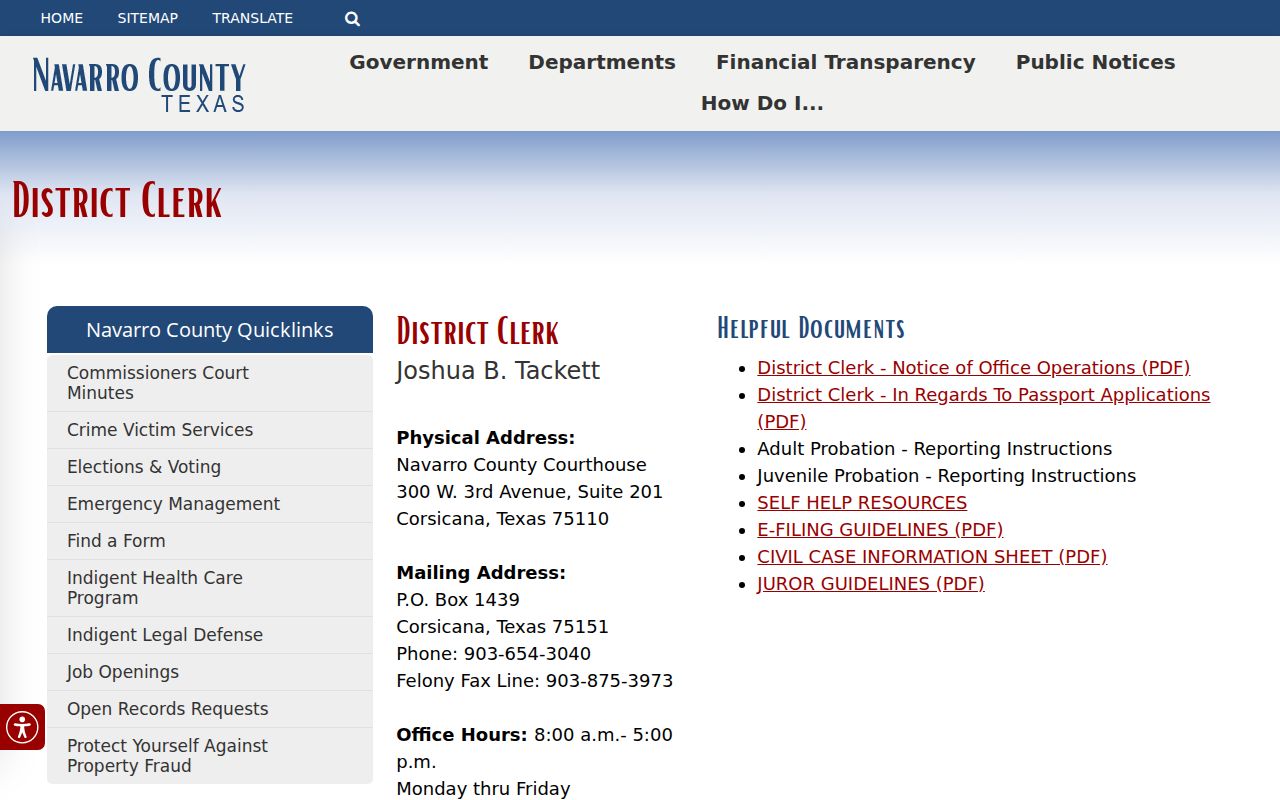
This official view marks the route to felony files and certified dispositions kept for the 13th District Court. The County Clerk's official page provides the separate misdemeanor route.
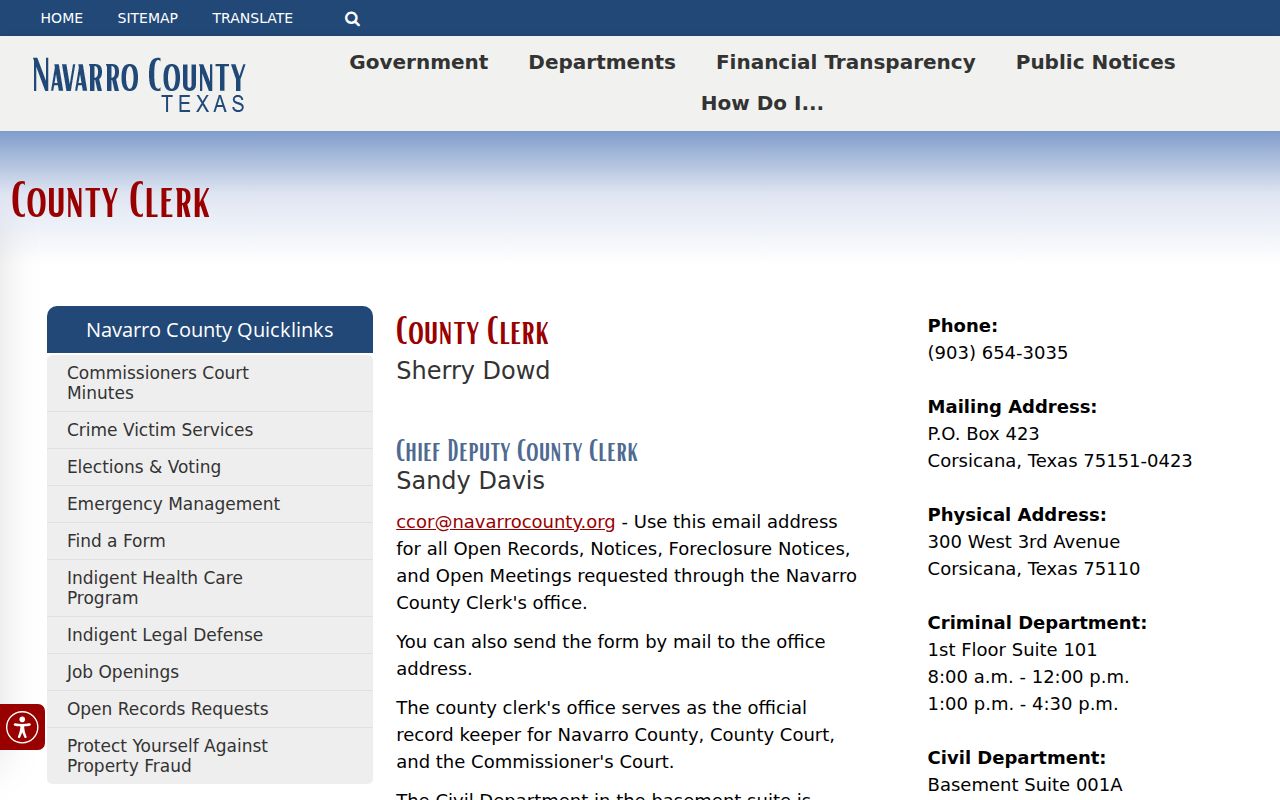
Its distinct counter and daily scanning practice show why offense level must be settled before requesting a Navarro County criminal file.
Searching Navarro County Case Records
Begin with the public-access gateway linked from the correct Navarro County clerk page. The vendor interface can change, so the county page is the sound entry point. County Clerk computerized records extend from 1995 forward. Older misdemeanor cases may require manual or archive retrieval. A portal miss is therefore a reason to call the proper counter, not proof that no Navarro County criminal court case exists.
- Choose the District Clerk for a felony, County Clerk for a Class A or B misdemeanor, or the issuing municipal or justice court for a fine-only case.
- Search by party name or cause number. Use the full legal surname and try a known spelling variant as a separate query.
- Narrow the results with the filing range and criminal case category. Match the court and filing date before opening a docket.
- Read the event list for the charging instrument, settings, plea or trial, judgment, sentence, and later revocation activity.
- Ask the clerk for the indictment or information, judgment, and certified disposition when the index lacks images or formal proof is needed.
The Navarro County portal inspection documented these fields and controls:
| Field Label | Type | Required | Notes |
|---|---|---|---|
| Search type | Tabs or dropdown | Yes | Select a party-name or case-number path. |
| Last or business name | Text | By path | Use the full surname and test variants separately. |
| First and middle name | Text | No | Helps narrow common Navarro County names. |
| Case number | Text | Alternative | Keep the punctuation and year prefix shown on court papers. |
| Case type and dates | Select and dates | No | Choose criminal and set a filed-from and filed-to range when offered. |
Navarro County Criminal Cases and re:SearchTX
re:SearchTX is the named statewide court portal, but it is not a dependable replacement for Navarro County's local criminal clerks. Texas Judicial Council material has said that the statewide public collection historically excluded criminal case records. A blank statewide query must not override a match at the District Clerk, County Clerk, municipal court, or justice court. The official re:SearchTX interface illustrates the statewide option and its limits for this record type.
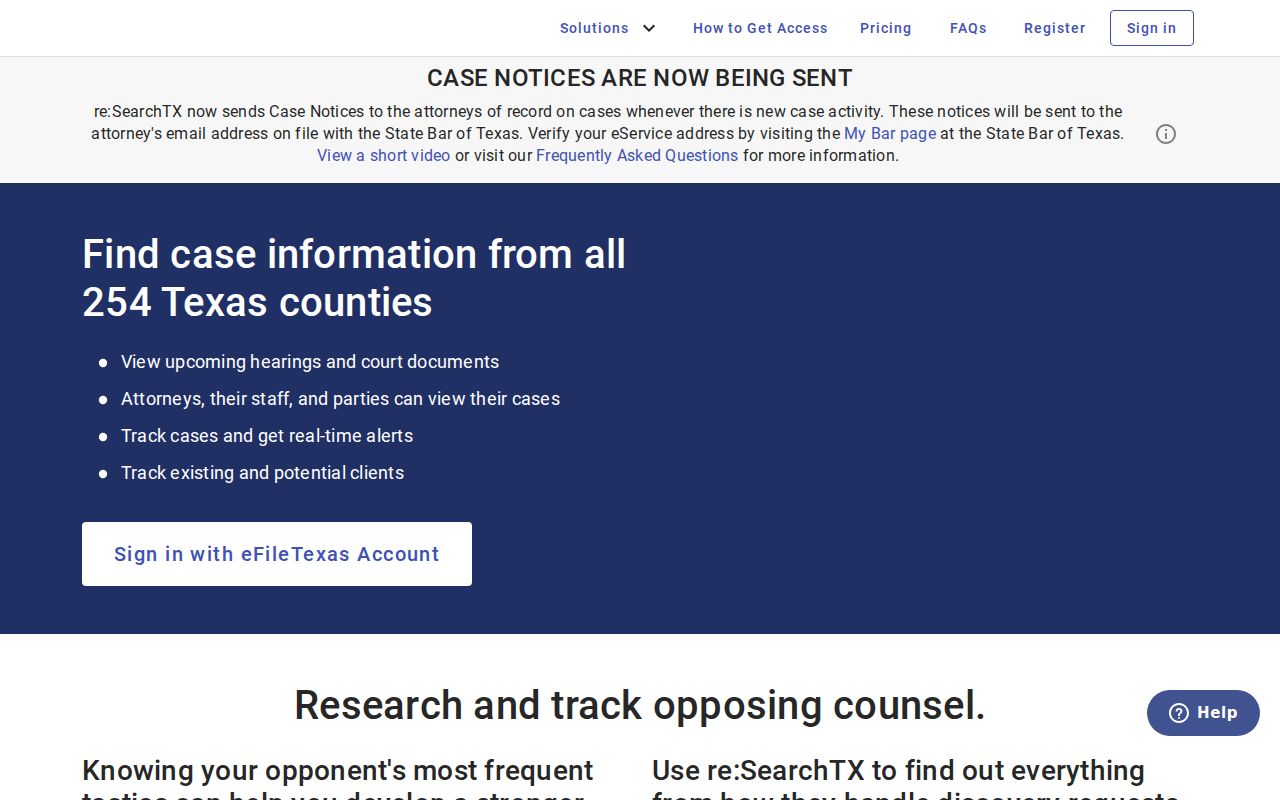
For a Navarro County criminal case, return to the local clerk gateway or counter when the statewide portal does not expose the file.
Note: A no-result screen can reflect court coverage, spelling, date range, archives, or restricted status rather than no case.
Inside a Navarro County Case File
A case index identifies the matter, but the document file tells what was alleged and decided. Navarro County dockets may show complaints, misdemeanor informations, felony indictments, bond entries, arraignment or waiver, motions, settings, pleas, trials, judgments, sentences, and motions to revoke or adjudicate. Financial entries can show fines, statutory costs, payments, or a balance when those fields are public. Document download access depends on the current portal and access rules.
| Case Number and Court | Identifies the cause, assigned Navarro County court, filing date, category, and status. |
|---|---|
| Charging Document | The complaint, information, or indictment states the filed counts and may differ from booked charges. |
| Docket Entries | A dated trail of filings, settings, motions, orders, pleas, trial events, and post-judgment activity. |
| Parties and Counsel | Lists the State of Texas, defendant, and public attorney-of-record information. |
| Disposition and Judgment | Shows whether a count ended in conviction, dismissal, acquittal, deferred adjudication, or another recorded result. |
| Sentence and Conditions | Records confinement, community supervision, financial terms, and a public revocation result when ordered. |
A certified judgment is the stronger choice when correcting a missing disposition at Texas DPS. DPS requires a certified court disposition, not a printout from an unofficial service.
Navarro County Criminal Case Forms
The 13th District Court publishes a notably specific set of local criminal forms. They include magistration, waiver of arraignment, trial announcement, jury waiver, plea packet, probation revocation, scheduling order, and trial-court certification. Each form corresponds to a point in the Navarro County case trail. A waiver of arraignment records that a formal courtroom reading was waived; it does not erase the charge. A plea packet reflects a proposed or entered resolution, while the signed judgment controls the recorded outcome.
The 13th District Court source displays the local felony court and its published materials.
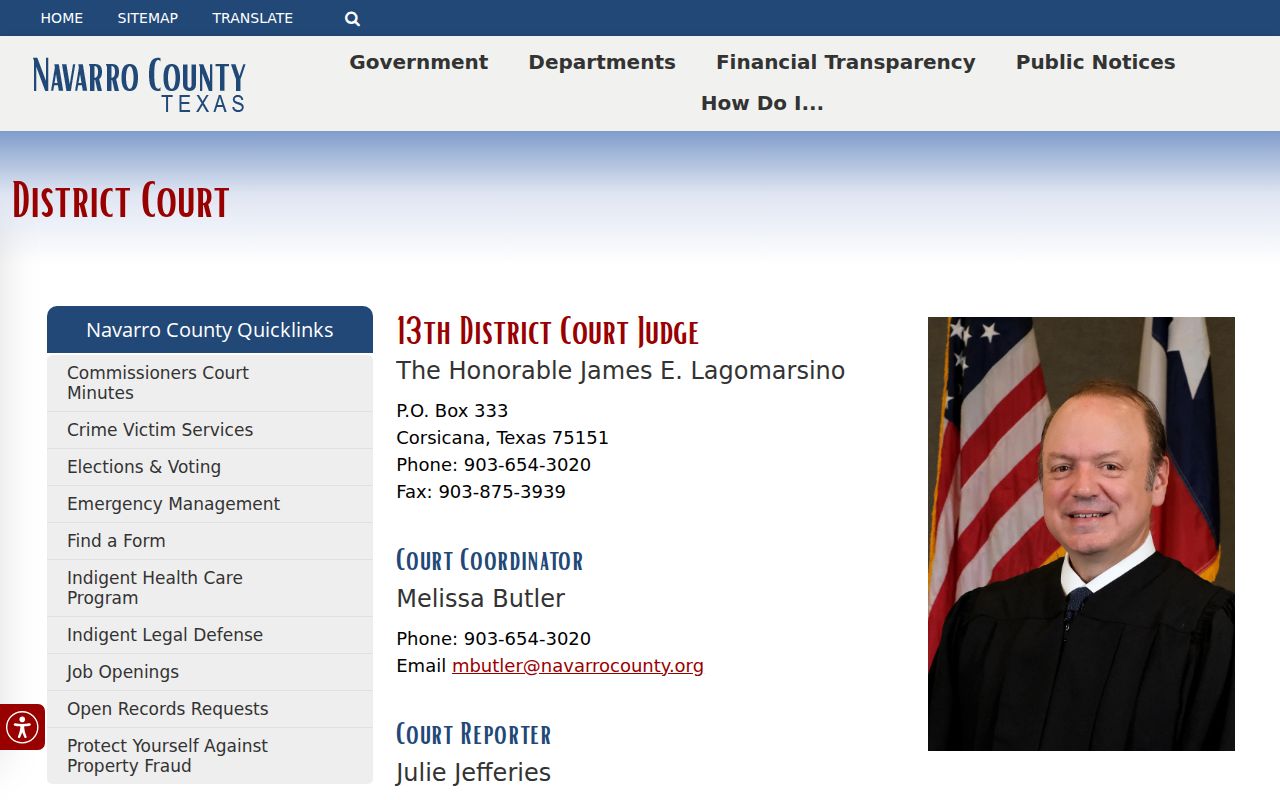
Those forms provide local landmarks for reading a Navarro County felony docket from first appearance through judgment or revocation.
How a Criminal Case Moves
A Navarro County case can begin with an arrest or complaint, followed by prompt magistration and a bond decision. The prosecutor then screens the facts. A misdemeanor may proceed by information, while a felony can move to a grand jury for an indictment. Arraignment or waiver comes before discovery, motions, and settings. The matter can end through a plea, trial, dismissal, acquittal, or other lawful disposition. A judgment and sentence follow a conviction or deferred result, and later appeal or supervision activity can add more entries.
Case flow: Charges Filed → Arraignment → Pretrial → Plea or Trial → Disposition → Sentencing
Dates are case-specific. Navarro County's docket entries and signed orders should be used instead of guessing how long a stage lasted.
Navarro County Recovery Court Case Records
The Navarro County District Attorney publishes Recovery Court nomination and participant materials as well as pretrial-diversion documents. A nomination comes before acceptance. Eligibility is program-specific and cannot be inferred from the charge label alone. Likewise, “pretrial diversion” describes a program path, not a final disposition term. The clerk's Navarro County criminal case file remains the place to verify what the court entered.
Program records can span more than one custodian. Filed agreements, orders, or final case outcomes may be in the clerk file, while treatment and supervision details may be confidential or held elsewhere. Readers reviewing their own Navarro County case should ask for named existing documents, such as the judgment or signed order, rather than asking the clerk to interpret program eligibility.
Reading Navarro County Case Outcomes
Short docket labels can hide key distinctions. “Disposed” means an outcome exists, but it does not itself mean guilty. The judgment or dismissal order supplies the answer. These terms help decode Navarro County criminal court cases:
- Disposition
- The legal outcome recorded for a charge or case.
- No bill
- A grand jury decision not to indict on the presented felony allegation.
- Deferred adjudication
- A plea or finding is deferred while community supervision is served; Texas may still treat it as public CCH information.
- Dismissal
- A count ended without a conviction on that count.
- Capias
- A court command to arrest, often tied to charging, nonappearance, or an order violation.
A booked charge, filed count, and final judgment can all differ. For the arrest-side document before filing, the county's arrest lookup channels identify the arresting agency and booking record.
Case Record Access & Restrictions
Public access does not make every field or paper open. Navarro County court files should not expose Social Security numbers, full sensitive identifiers, protected victim or minor details, or sealed and expunged material. Juvenile records are generally restricted. An online view can omit documents that are available by a direct request, and a clerk may provide redacted public portions rather than an unedited file.
Texas court-access guidance distinguishes judicial administrative records from court case records. The Texas Public Information Act is not a universal substitute for asking the clerk who keeps the case. Request the docket, charging instrument, judgment, or certified disposition by name. County Clerk charges ordinary requesters for misdemeanor copies, while current per-page and certification amounts should be confirmed before ordering. Ask District Clerk for its current quote as well.